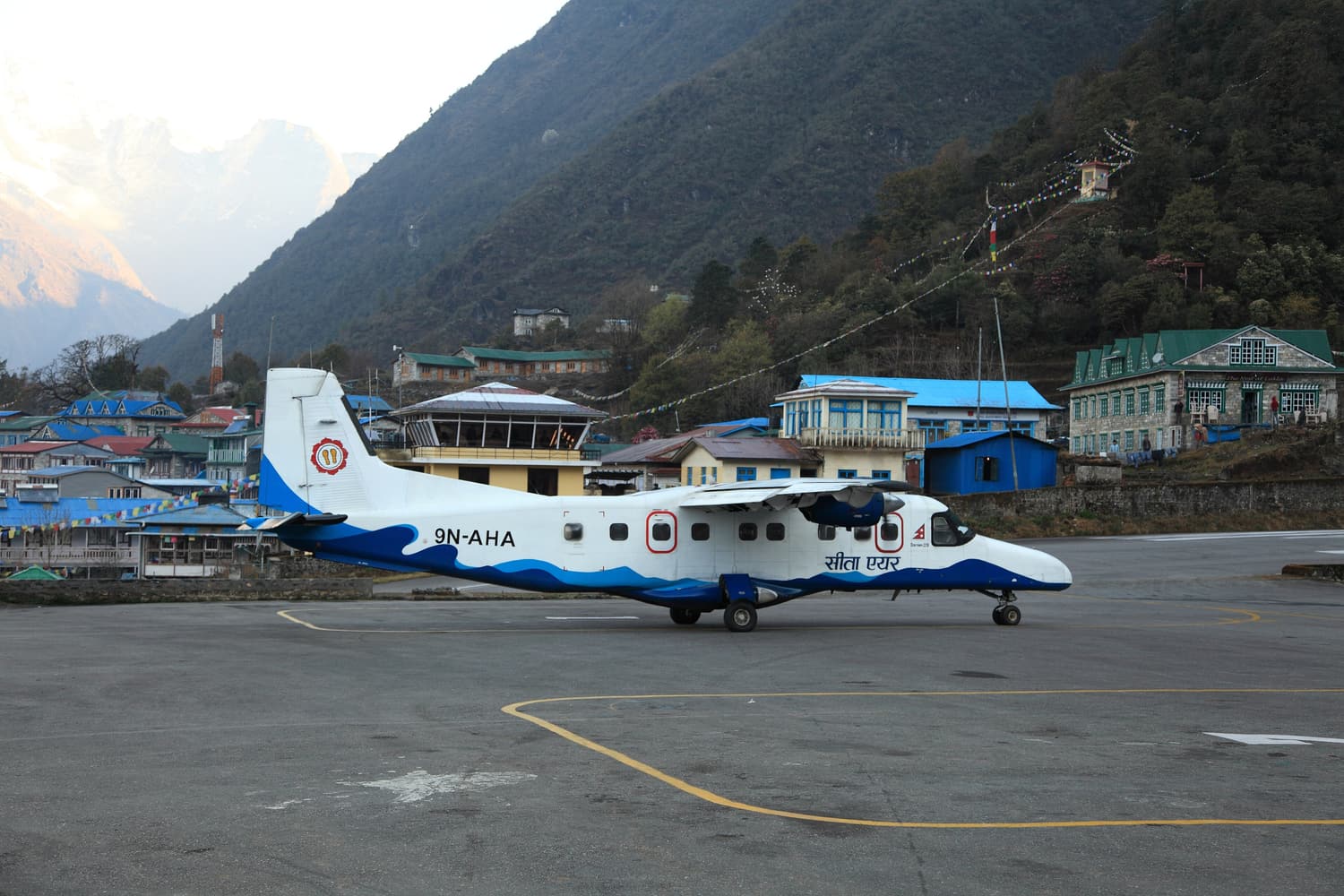
Almost every Everest Base Camp trek starts in Lukla (2,860 m), a village with a short, steep airstrip — Tenzing-Hillary Airport — perched on a mountainside above the Dudh Koshi. There is no road all the way to Lukla, so you either fly in or add several days of jeep and walking.
Here are the realistic options, compared.
The options at a glance
| How | Time | Rough cost | Best for |
|---|---|---|---|
| Flight from Kathmandu (TIA) | ≈ 30–40 min | often US$200–250 one way | Off-season; the quickest start |
| Drive to Ramechhap + flight | 4–5 h drive + ≈ 20 min | flight similar + transfer | Peak seasons (most flights) |
| Helicopter (shared or charter) | ≈ 45–60 min | from a few hundred US$ per seat | Weather backlogs, tight schedules |
| Jeep via Salleri + walk | 1–3 days | low, but slow | Budget, flight-averse travellers |
| Classic walk-in from Jiri/Shivalaya | 5–7 extra days | low | Time-rich trekkers, better acclimatisation |
1. Flying to Lukla from Kathmandu
Small twin-engine planes (Dornier 228s and Twin Otters) operated by domestic airlines such as Tara Air, Summit Air and Sita Air fly to Lukla in the early morning, when the air is calmest. The flight takes around 30–40 minutes, and the landing — uphill onto a runway of about 530 metres ending at a rock wall — is famous in its own right. Sit on the left side flying in for mountain views.
Foreigner fares are typically in the region of US$200–250 each way and change regularly; most guided treks from Kathmandu include them. Compare treks with flights included.
2. The Ramechhap (Manthali) diversion
To ease congestion at Kathmandu’s Tribhuvan airport, Nepal moves most Lukla flights to Manthali Airport in Ramechhap during the busy spring and autumn seasons. That means a drive of roughly 130 km — usually 4–5 hours, often leaving Kathmandu at 1–3 am to make the first flights. The flight from Manthali to Lukla takes only about 20 minutes.
3. Weather delays — and why you need buffer days
Lukla flights operate on visual flight rules. Cloud in Lukla, Kathmandu or anywhere en route cancels them, and a backlog can build over several days — especially in the shoulder months and the monsoon. Always keep at least one, ideally two, spare days at the end of your trip before an international flight. If you are stuck, a shared helicopter seat out of Lukla is the usual (expensive) escape.
4. Baggage limits
Expect a combined allowance of around 15 kg (commonly 10 kg checked plus 5 kg hand baggage), with excess charged per kilo and not always guaranteed to fly on the same plane. Pack light, leave city clothes at your Kathmandu hotel (most offer free storage) and let your porter’s duffel carry the rest.
5. Helicopters
Shared helicopter seats between Kathmandu (or Ramechhap) and Lukla are widely sold, particularly when bad weather grounds the planes. They can fly in lower cloud and cost several times the plane fare. Many travellers use them only on the way out, to protect an international connection.
6. By road: jeeps via Salleri and the old walk-in
If you would rather not fly, shared jeeps run from Kathmandu to Salleri/Phaplu in the Solukhumbu (a long, rough day of around 8–11 hours). From there, rough roads now continue towards the Lukla area, and you walk the last day or two to join the main trail. It is slow and bumpy, but cheap and immune to flight cancellations — and the extra days at middle altitude help acclimatisation.
Purists can still follow Hillary and Tenzing’s 1953 approach from Jiri or Shivalaya, adding five to seven days of beautiful, little-trodden trail through the lower hills.
Coming from elsewhere
- Arriving in Nepal: Tribhuvan International Airport (KTM) in Kathmandu is the gateway; visas on arrival are available for most nationalities.
- From Pokhara: fly or bus back to Kathmandu first — there are no direct Lukla flights.
- From Tibet: Everest’s north side is a completely separate trip from Lhasa; see our North Base Camp guide.